Alexander Hamilton Went and Ate Some Ham Again
| Burr–Hamilton Duel | |
|---|---|
 A 20th-century rendering by J. Mund depicting the July eleven, 1804, duel betwixt Aaron Burr and Alexander Hamilton. Notation the anachronistic clothing: wigs and tricorn hats were outdated past the beginning of the 19th century. | |
| Location | Weehawken, New Jersey |
| Coordinates | forty°46′13″Due north 74°01′01″W / xl.770230°N 74.016944°W / 40.770230; -74.016944 |
| Date | July 11, 1804 (1804-07-xi) |
| Target | Aaron Burr, Alexander Hamilton |
| Attack blazon | Duel |
| Weapons | Wogdon & Barton pistols |
| Deaths | Alexander Hamilton |
| Injured | 1 fatality |
| Perpetrators | Aaron Burr, Alexander Hamilton |
The Burr–Hamilton duel took place in Weehawken, New Jersey, between Aaron Burr, the Vice President of the United States, and Alexander Hamilton, the first and former Secretary of the Treasury, on the morn of July xi, 1804. The duel was the culmination of a bitter rivalry that had developed betwixt both men who had go high-profile politicians in postcolonial America. In the duel Burr fatally shot Hamilton, while Hamilton fired into a tree branch higher up and behind Burr's caput. Hamilton was taken dorsum across the Hudson River and died the following day in New York.[1]
The death of Hamilton led to the permanent weakening of the Federalist Political party and its demise in American domestic politics. Information technology also effectively ended the political career of Burr, who was vilified for shooting Hamilton; he never held another loftier office after his tenure of Vice President ended in 1805.
Groundwork [edit]

The Burr–Hamilton duel is i of the most famous personal conflicts in American history. It was a pistol duel that arose from long-continuing personal bitterness that developed between the ii men over the class of several years. Tension rose with Hamilton's journalistic defamation of Burr'due south character during the 1804 New York gubernatorial race, in which Burr was a candidate.
The duel was fought at a time when the practice was being outlawed in the northern United States, and it had immense political ramifications. Burr survived the duel and was indicted for murder in both New York and New Bailiwick of jersey, though these charges afterwards were either dismissed or resulted in acquittal. The harsh criticism and animosity directed toward Burr following the duel brought an end to his political career. The Federalist Party was already weakened by the defeat of John Adams in the presidential election of 1800 and was further weakened past Hamilton'southward decease.
The duel was the final skirmish of a long conflict between Autonomous-Republicans and Federalists. The conflict began in 1791 when Burr won a Us Senate seat from Philip Schuyler, Hamilton'due south father-in-law, who would have supported Federalist policies. (Hamilton was the Secretarial assistant of the Treasury at the time.) The Electoral Higher and so deadlocked in the ballot of 1800, during which Hamilton'southward maneuvering in the House of Representatives caused Thomas Jefferson to exist named president and Burr vice president.[2] At the time, the most votes resulted in an election win, while second place received the Vice Presidency. In that location were only proto-political parties at the fourth dimension, equally disdainfully noted in President Washington's Adieu Address, and no shared tickets.
Hamilton's animosity toward Burr was severe and well-documented in personal letters to his friend and compatriot James McHenry. The post-obit quotation from one of these letters on January 4, 1801, exemplifies his bitterness:
"Zip has given me so much chagrin as the Intelligence that the Federal party were thinking seriously of supporting Mr. Burr for president. I should consider the execution of the plan as devoting the country and signing their own death warrant. Mr. Burr will probably make stipulations, but he will laugh in his sleeve while he makes them and will break them the first moment it may serve his purpose."[3]
Hamilton details the many charges that he has against Burr in a more than extensive letter written shortly afterward, calling him a "profligate, a voluptuary in the extreme", accusing him of corruptly serving the interests of the Holland Land Company while a member of the legislature, criticizing his military committee and accusing him of resigning it under false pretenses, and many more serious accusations.[three]

Morgan Lewis, endorsed by Hamilton, defeated Burr in the 1804 New York gubernatorial election.
It became clear that Jefferson would drop Burr from his ticket in the 1804 election, so the Vice President ran for the governorship of New York instead.[ citation needed ] Hamilton campaigned vigorously confronting Burr, who was running as an independent, causing him to lose to Morgan Lewis, a Democratic-Republican endorsed by Hamilton.[ commendation needed ]
Both men had been involved in duels in the past. Hamilton had been the second in several duels, although never the duelist himself, but he was involved in more than than a dozen affairs of honor[4] prior to his fatal come across with Burr, including disputes with William Gordon (1779), Aedanus Burke (1790), John Francis Mercer (1792–1793), James Nicholson (1795), James Monroe (1797), and Ebenezer Purdy and George Clinton (1804). He also served as a 2nd to John Laurens in a 1779 duel with General Charles Lee, and to legal client John Auldjo in a 1787 duel with William Pierce.[five] Hamilton also claimed that he had one previous honor dispute with Burr,[6] while Burr stated that at that place were ii.[vii] [eight]
Election of 1800 [edit]
Burr and Hamilton first came into public opposition during the U.s.a. presidential election of 1800. Burr ran for president on the Autonomous-Republican ticket, along with Thomas Jefferson, confronting President John Adams (the Federalist incumbent) and his vice presidential running mate Charles C. Pinckney. Balloter College rules at the fourth dimension gave each elector two votes for president. The candidate who received the second most votes became vice president.
The Democratic-Republican Political party planned to take 72 of their 73 electors vote for both Jefferson and Burr, with the remaining elector voting simply for Jefferson. The electors failed to execute this plan, so Burr and Jefferson were tied with 73 votes each. The Constitution stipulated that if two candidates with an Electoral Higher majority were tied, the election would be moved to the House of Representatives—which was controlled by the Federalists, at this point, many of whom were loath to vote for Jefferson. Although Hamilton had a long-standing rivalry with Jefferson stemming from their tenure equally members of George Washington's cabinet, he regarded Burr as far more dangerous and used all his influence to ensure Jefferson'due south ballot. On the 36th ballot, the House of Representatives gave Jefferson the presidency, with Burr becoming vice president.
Charles Cooper's letter [edit]
On April 24, 1804, the Albany Register published a letter opposing Burr's gubernatorial candidacy[9] which was originally sent from Charles D. Cooper to Hamilton's father-in-law, onetime Senator Philip Schuyler.[x] It made reference to a previous argument by Cooper: "Full general Hamilton and Guess Kent take declared in substance that they looked upon Mr. Burr to be a dangerous human being, and 1 who ought not exist trusted with the reins of authorities." Cooper went on to emphasize that he could describe in item "a still more despicable opinion which General Hamilton has expressed of Mr. Burr" at a political dinner.[11]
Burr responded in a letter delivered by William P. Van Ness which pointed specially to the phrase "more than despicable" and demanded "a prompt and unqualified acquittance or deprival of the utilize of any expression which would warrant the exclamation of Dr. Cooper." Hamilton's verbose reply on June 20, 1804, indicated that he could non be held responsible for Cooper's estimation of his words (withal he did not fault that interpretation), last that he would "abide the consequences" should Burr remain unsatisfied.[12] A recurring theme in their correspondence is that Burr seeks avowal or disavowal of anything that could justify Cooper'due south characterization, while Hamilton protests that at that place are no specifics.

This July 31, 1804 article reviewed the extended series of communications betwixt Burr and Hamilton leading up to the duel, and criticized the "barbarous custom" of dueling.
Burr replied on June 21, 1804, also delivered past Van Ness, stating that "political opposition tin never absolve gentlemen from the necessity of a rigid adherence to the laws of honor and the rules of decorum".[13] Hamilton replied that he had "no other respond to give than that which has already been given". This alphabetic character was delivered to Nathaniel Pendleton on June 22 but did not attain Burr until June 25.[xiv] The delay was due to negotiation betwixt Pendleton and Van Ness in which Pendleton submitted the following newspaper:
General Hamilton says he cannot imagine what Dr. Cooper may have alluded, unless it were to a chat at Mr. Taylor'southward, in Albany, concluding winter (at which he and Full general Hamilton were present). General Hamilton cannot recollect distinctly the particulars of that chat, so equally to undertake to echo them, without running the risk of varying or omitting what might be deemed important circumstances. The expressions are entirely forgotten, and the specific ideas imperfectly remembered; simply to the best of his recollection it consisted of comments on the political principles and views of Colonel Burr, and the results that might be expected from them in the event of his election as Governor, without reference to whatsoever particular instance of past conduct or private grapheme.[fifteen]
Eventually, Burr issued a formal challenge and Hamilton accepted.[16] Many historians have considered the causes of the duel to be flimsy and accept thus characterized Hamilton as "suicidal", Burr every bit "malicious and murderous", or both.[17] Thomas Fleming offers the theory that Burr may have been attempting to recover his honour by challenging Hamilton, whom he considered to be the just gentleman among his detractors, in response to the slanderous attacks confronting his character published during the 1804 gubernatorial campaign.[xviii]
Hamilton'southward reasons for not engaging in a duel included his roles as father and married man, putting his creditors at risk, and placing his family'southward welfare in jeopardy, just he felt that information technology would be incommunicable to avoid a duel because he had made attacks on Burr which he was unable to recant, and because of Burr's behavior prior to the duel. He attempted to reconcile his moral and religious reasons and the codes of honor and politics. Joanne Freeman speculates that Hamilton intended to accept the duel and throw abroad his shot in order to satisfy his moral and political codes.[xix]
Duel [edit]
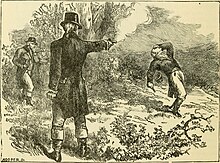
Artistic impression of Burr's shot
In the early morning of July 11, 1804, Burr and Hamilton departed from Manhattan by separate boats and rowed across the Hudson River to a spot known as the Heights of Weehawken, New Jersey, a popular dueling footing below the towering cliffs of the New Jersey Palisades.[20] Dueling had been prohibited in both New York and New Bailiwick of jersey, just Hamilton and Burr agreed to go to Weehawken because New Jersey was not as aggressive as New York in prosecuting dueling participants. The same site was used for 18 known duels between 1700 and 1845, and it was not far from the site of the 1801 duel that killed Hamilton'due south eldest son Philip Hamilton.[21] [22] They also took steps to give all witnesses plausible deniability in an endeavour to shield themselves from prosecution. For example, the pistols were transported to the island in a portmanteau, enabling the rowers to say nether oath that they had not seen any pistols. They as well stood with their backs to the duelists.[23]
Burr, William Peter Van Ness (his second), Matthew 50. Davis, another man (frequently identified every bit John Swarthout), and the rowers all reached the site at half-dozen:thirty a.yard., whereupon Swarthout and Van Ness started to articulate the underbrush from the dueling ground. Hamilton, Judge Nathaniel Pendleton (his 2nd), and Dr. David Hosack arrived a few minutes before seven. Lots were bandage for the selection of position and which 2d should start the duel. Both were won past Hamilton's second, who chose the upper edge of the ledge for Hamilton, facing the city.[24] However, Joseph Ellis claims that Hamilton had been challenged and therefore had the pick of both weapon and position. Nether this account, Hamilton himself chose the upstream or north side position.[25]
Some first-hand accounts of the duel agree that 2 shots were fired, but some say only Burr fired, and the seconds disagreed on the intervening time between them. It was common for both principals in a duel to fire a shot at the footing to exemplify backbone, and and then the duel could come to an stop. Hamilton apparently fired a shot above Burr's head. Burr returned fire and hitting Hamilton in the lower abdomen in a higher place the right hip.[26] The large-quotient lead ball ricocheted off Hamilton'due south third or second false rib, fracturing it and causing considerable impairment to his internal organs, particularly his liver and diaphragm, before lodging in his commencement or second lumbar vertebra. According to Pendleton'south account, Hamilton collapsed almost immediately, dropping the pistol involuntarily, and Burr moved toward him in a speechless way (which Pendleton deemed to be indicative of regret) before being hustled away behind an umbrella by Van Ness because Hosack and the rowers were already approaching.[26]
It is entirely uncertain which primary fired showtime, as both seconds' backs were to the duel in accordance with the pre-arranged regulations so that they could testify that they "saw no fire". Later much enquiry to determine the actual events of the duel, historian Joseph Ellis gives his best judge:
Hamilton did burn his weapon intentionally, and he fired first. Just he aimed to miss Burr, sending his ball into the tree to a higher place and behind Burr's location. In and then doing, he did not withhold his shot, only he did waste it, thereby honoring his pre-duel pledge. Meanwhile, Burr, who did not know about the pledge, did know that a projectile from Hamilton's gun had whizzed by him and crashed into the tree to his rear. According to the principles of the lawmaking duello, Burr was perfectly justified in taking deadly aim at Hamilton and firing to kill.
David Hosack'southward business relationship [edit]
Hosack wrote his account on August 17, about one month after the duel had taken place. He testified that he had merely seen Hamilton and the two seconds disappear "into the woods", heard two shots, and rushed to observe a wounded Hamilton. He also testified that he had not seen Burr, who had been hidden behind an umbrella by Van Ness.[27] He gives a very clear film of the events in a letter to William Coleman:
When called to him upon his receiving the fatal wound, I found him half sitting on the ground, supported in the arms of Mr. Pendleton. His countenance of expiry I shall never forget. He had at that instant but strength to say, "This is a mortal wound, doc;" when he sunk away, and became to all advent lifeless. I immediately stripped upward his clothes, and soon, alas I ascertained that the direction of the ball must accept been through some vital function. His pulses were not to be felt, his respiration was entirely suspended, and, upon laying my mitt on his eye and perceiving no motion at that place, I considered him as irrecoverably gone. I, nonetheless, observed to Mr. Pendleton, that the only chance for his reviving was immediately to get him upon the water. We therefore lifted him upwards, and carried him out of the forest to the margin of the depository financial institution, where the bargemen aided usa in carrying him into the boat, which immediately put off. During all this time I could non discover the to the lowest degree symptom of returning life. I now rubbed his face, lips, and temples with spirits of hartshorn, applied it to his neck and breast, and to the wrists and palms of his hands, and endeavoured to pour some into his mouth.[28]
Hosack goes on to say that Hamilton had revived after a few minutes, either from the hartshorn or fresh air. He finishes his letter of the alphabet:
Soon after recovering his sight, he happened to bandage his center upon the case of pistols, and observing the one that he had had in his mitt lying on the exterior, he said, "Take intendance of that pistol; it is undischarged, and still artsy; it may become off and do impairment. Pendleton knows" (attempting to turn his head towards him) "that I did non intend to burn at him." "Aye," said Mr. Pendleton, understanding his wish, "I accept already made Dr. Hosack acquainted with your conclusion as to that." He and so airtight his eyes and remained at-home, without whatsoever disposition to speak; nor did he say much later on, except in respond to my questions. He asked me one time or twice how I establish his pulse; and he informed me that his lower extremities had lost all feeling, manifesting to me that he entertained no hopes that he should long survive.[28]
Argument to the press [edit]
Pendleton and Van Ness issued a printing statement about the events of the duel which pointed out the agreed-upon dueling rules and events that transpired. It stated that both participants were gratis to open fire one time they had been given the order to present. Subsequently first fire had been given, the opponent'due south 2nd would count to three, whereupon the opponent would fire or sacrifice his shot.[29] Pendleton and Van Ness disagree as to who fired the first shot, but they concur that both men had fired "within a few seconds of each other" (as they must have; neither Pendleton nor Van Ness mentions counting down).[29]
In Pendleton'south amended version of the statement, he and a friend went to the site of the duel the day later Hamilton's decease to detect where Hamilton's shot went. The statement reads:
They ascertained that the brawl passed through the limb of a cedar tree, at an elevation of about twelve feet and a one-half, perpendicularly from the ground, between thirteen and xiv feet from the marking on which General Hamilton stood, and almost four feet wide of the direct line betwixt him and Col. Burr, on the right side; he having fallen on the left.[30]
Hamilton'southward intentions [edit]
Hamilton wrote a alphabetic character earlier the duel titled Statement on Impending Duel with Aaron Burr [31] in which he stated that he was "strongly opposed to the practice of dueling" for both religious and practical reasons. "I have resolved," it connected, "if our interview is conducted in the usual manner, and it pleases God to give me the opportunity, to reserve and throw away my kickoff burn down, and I accept thoughts even of reserving my second fire."[32] [33]
Hamilton regained consciousness later on existence shot and told Dr. Hosack that his gun was still loaded and that "Pendleton knows I did not hateful to fire at him." This is evidence for the theory that Hamilton intended not to fire, honoring his pre-duel pledge, and only fired accidentally upon beingness striking.[30] Such an intention would have violated the protocol of the code duello and, when Burr learned of it, he responded: "Contemptible, if truthful."[34] Hamilton could have thrown away his shot past firing into the ground, thus possibly signaling Burr of his purpose.
Modern historians accept debated to what extent Hamilton's statements and letter represent his truthful beliefs, and how much of this was a deliberate attempt to permanently ruin Burr if Hamilton were killed. An instance of this may exist seen in what one historian has considered to be deliberate attempts to provoke Burr on the dueling basis:
Hamilton performed a series of deliberately provocative actions to ensure a lethal event. Equally they were taking their places, he asked that the proceedings stop, adjusted his spectacles, and slowly, repeatedly, sighted along his pistol to exam his aim.[35]
Burr's intentions [edit]
There is show that Burr intended to kill Hamilton.[36] The afternoon after the duel, he was quoted as saying that he would have shot Hamilton in the heart had his vision not been impaired by the morning mist.[37] English philosopher Jeremy Bentham met with Burr in England in 1808, iv years after the duel, and Burr claimed to accept been sure of his power to impale Hamilton. Bentham concluded that Burr was "piddling ameliorate than a murderer."[38]
There is as well bear witness in Burr'south defense. Had Hamilton apologized for his "more despicable opinion of Mr. Burr",[39] all would have been forgotten. All the same, the code duello required that injuries which needed an explanation or apology must be specifically stated. Burr's accusation was then unspecific that it could've referred to anything that Hamilton had said over 15 years of political rivalry. Despite this, Burr insisted on an reply.[forty]
Burr knew of Hamilton's public opposition to his presidential run in 1800. Hamilton made confidential statements confronting him, such as those enumerated in his letter of the alphabet to Supreme Court Justice John Rutledge. In the zipper to that letter, Hamilton argued against Burr'south character on numerous scores: he suspected Burr "on stiff grounds of having corruptly served the views of the The netherlands Company;" "his very friends practice not insist on his integrity"; "he will court and use able and daring scoundrels;" he seeks "Supreme power in his own person" and "volition in all likelihood attempt a usurpation," and so forth.[41]
Pistols [edit]

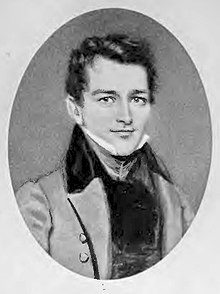
Philip Hamilton was killed in a duel three years before, well-nigh the spot of the Burr–Hamilton duel.
The pistols used in the duel belonged to Hamilton's blood brother-in-police force John Barker Church, who was a business partner of both Hamilton and Burr.[42] Later legend claimed that these pistols were the same ones used in a 1799 duel between Church and Burr in which neither homo was injured.[43] [44] Burr, however, wrote in his memoirs that he supplied the pistols for his duel with Church, and that they belonged to him.[45] [44]
The Wogdon & Barton dueling pistols incorporated a pilus-trigger feature that could be prepare by the user.[43] [46] Hamilton was familiar with the weapons and would have been able to use the pilus trigger. However, Pendleton asked him before the duel whether he would apply the "hair-spring", and Hamilton reportedly replied, "Not this time."[24]
Hamilton'south son Philip and George Eacker probable used the Church weapons in the 1801 duel in which Philip died, three years earlier the Burr–Hamilton duel.[43] They were kept at Church'south estate Belvidere until the late 19th century;[47] they were sold in 1930 to the Chase Manhattan Bank (at present role of JP Morgan Hunt), which traces its descent back to the Manhattan Company founded past Burr, and are on display in the depository financial institution'due south headquarters at 270 Park Avenue in New York City.[48]
Aftermath [edit]
After existence attended by Hosack, the mortally wounded Hamilton was taken to the home of William Bayard Jr. in New York, where he received communion from Bishop Benjamin Moore.[49] [l] He died the next day after seeing his wife Elizabeth and their children, in the presence of more than xx friends and family members; he was buried in the Trinity Churchyard Cemetery in Manhattan. (Hamilton was an Episcopalian at his expiry.)[51]
Burr was charged with murder in New York and New Jersey, but neither charge reached trial. In Bergen County, New Jersey, a thou jury indicted him for murder in November 1804,[20] simply the New Jersey Supreme Court quashed it on a movement from Colonel Ogden.[52] Burr fled to St. Simons Island, Georgia, and stayed at the plantation of Pierce Butler, but he shortly returned to Washington, D.C. to complete his term as vice president.[53] [54]

This July 25, 1804 commodity reflected extreme lamentation over Hamilton'south death, and described the plan for his funeral procession and other tributes, including a 30-solar day wearing of a commemorative black armband ("crape") by members of the Society of the Cincinnati of Pennsylvania of which Hamilton had been President General.[55]
He presided over the impeachment trial of Samuel Hunt "with the dignity and impartiality of an angel, but with the rigor of a devil", according to a Washington newspaper. Burr's heartfelt farewell spoken communication to the Senate in March 1805 moved some of his harshest critics to tears.[56]
Memorials and monuments [edit]

The bedrock where Hamilton may have rested

A bust of Hamilton from 1935
The first memorial to the duel was constructed in 1806 by the Saint Andrew's Society of the State of New York of which Hamilton was a member.[57] A 14-foot marble cenotaph was constructed where Hamilton was believed to have fallen, consisting of an obelisk topped past a flaming urn and a plaque with a quotation from Horace, the whole structure surrounded by an iron fence.[58] Duels connected to be fought at the site and the marble was slowly vandalized and removed for souvenirs, with nothing remaining by 1820. The memorial'southward plaque survived, all the same, turning up in a junk store and finding its mode to the New-York Historical Society in Manhattan where it nevertheless resides.[59]
From 1820 to 1857, the site was marked by two stones with the names Hamilton and Burr placed where they were thought to accept stood during the duel, merely a road was built through the site in 1858 from Hoboken, New Jersey, to Fort Lee, New Jersey; all that remained of those memorials was an inscription on a boulder where Hamilton was thought to have rested after the duel, but in that location are no primary accounts which confirm the boulder anecdote. Railroad tracks were laid straight through the site in 1870, and the boulder was hauled to the top of the Palisades where information technology remains today.[sixty] An iron contend was built around it in 1874, supplemented by a bosom of Hamilton and a plaque. The bosom was thrown over the cliff on Oct 14, 1934, by vandals and the caput was never recovered; a new bosom was installed on July 12, 1935.[61] The plaque was stolen by vandals in the 1980s and an abbreviated version of the text was inscribed on the indentation left in the bedrock, which remained until the 1990s when a granite pedestal was added in forepart of the bedrock and the bust was moved to the top of the pedestal. New markers were added on July 11, 2004, the 200th ceremony of the duel.[62]
Anti-dueling motion in New York country [edit]
In the months and years following the duel, a movement started to end the practice. Eliphalet Nott, the pastor at an Albany church attended by Hamilton's begetter-in-law, Philip Schuyler, gave a sermon that was presently reprinted, "A Discourse, Delivered in the North Dutch Church, in the Urban center of Albany, Occasioned by the Ever to be Lamented Expiry of General Alexander Hamilton, July 29, 1804". In 1806, Lyman Beecher delivered an anti-dueling sermon, later reprinted in 1809 by the Anti-Dueling Association of New York. The covers and some pages of both pamphlets:
-
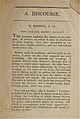
Opening text of 1804 sermon
-

Anti-Dueling Association of New York pamphlet, Remedy, 1809
-

Resolutions, Anti-Dueling Clan of North.Y., from Remedy pamphlet, 1809
-
Address to the electorate, from Remedy pamphlet
In popular culture [edit]
The rules of dueling researched by historian Joanne B. Freeman provided inspiration for the vocal "X Duel Commandments" in the Broadway musical Hamilton.[63] The songs "Alexander Hamilton", "Your Obedient Servant", and "The World Was Wide Enough" also refer to the duel. The musical compresses the timeline for Burr and Hamilton's grievance, depicting Burr's challenge every bit a result of Hamilton's endorsement of Jefferson rather than the gubernatorial election. In Hamilton, the penultimate duel scene depicts a resolved Hamilton who intentionally aims his pistol at the sky and a regretful Burr who realizes this too belatedly and has already fired his shot.
Descendants of Burr and Hamilton held a re-enactment of the duel about the Hudson River for the duel's bicentennial in 2004. Douglas Hamilton, fifth great-grandson of Alexander Hamilton, faced Antonio Burr, a descendant of Aaron Burr's cousin. More than 1,000 people attended information technology, including an estimated sixty descendants of Hamilton and xl members of the Aaron Burr Association.[64] The Alexander Hamilton Awareness Order has been hosting the Celebrate Hamilton program since 2012 to commemorate the Burr–Hamilton Duel and Alexander Hamilton's life and legacy.[65]
Run into also [edit]
- List of feuds in the United States
Notes [edit]
- ^ "Today in History: July 11". Library of Congress. Retrieved Apr 23, 2007.
- ^ See, for case, "Jefferson is in every view less dangerous than Burr": Hamilton on the election of 1800 (Alphabetic character from Alexander Hamilton to Harrison Gray Otis: Dec 23, 1800).
- ^ a b Bernard C. Steiner and James McHenry, The life and correspondence of James McHenry (Cleveland: Burrows Brothers Co., 1907).
- ^ Freeman, Joanne B. (2002). Affairs of Award: National Politics in the New Republic. Yale University Press. pp. 326–327.
- ^ Freeman, 1996, pp. 294–295.
- ^ Nathaniel Pendleton to Van Ness. June 26, 1804. Hamilton Papers, 26:270.
- ^ Burr to Charles Biddle; July 18, 2004. Papers of Aaron Burr, 2: 887.
- ^ Additionally, Hamilton's son Philip was killed in a November 23, 1801, duel with George I. Eacker, initiated after Philip and his friend Richard Price engaged in "hooliganish" beliefs in Eacker'due south box at the Park Theatre (Manhattan, New York). This was in response to a speech that Eacker had made on July three, 1801, that was critical of Hamilton. Philip and his friend both challenged Eacker to duels when he called them "damned rascals" (Fleming, 1999, pp. 7–9). Cost's duel (as well at Weehawken) resulted in nothing more than than four missed shots, and Hamilton advised his son to delope (throw away his shot). Notwithstanding, both Philip and Eacker stood shotless for a minute later the command "present", then Philip leveled his pistol, causing Eacker to fire, mortally wounding Philip and sending his shot awry.
- ^ Cooper, Charles D. Apr 24, 1804. Albany Annals.
- ^ Cooper to Philip Schuyler. Hamilton Papers. April 23, 1804. 26: 246.
- ^ Hamilton, John Church (1879). Life of Alexander Hamilton . Retrieved Apr twenty, 2015.
- ^ "From Alexander Hamilton to Aaron Burr, June 20, 1804". Founders.athenaeum.gov. June 29, 2016. Retrieved July 9, 2016.
- ^ "To Alexander Hamilton from Aaron Burr, June 21, 1804". Founders.archives.gov. June 29, 2016. Retrieved July 9, 2016.
- ^ "From Alexander Hamilton to Aaron Burr, June 22, 1804". Founders.archives.gov. June 29, 2016. Retrieved July 9, 2016.
- ^ Winfield, 1875, pp. 216–217.
- ^ Winfield, 1875, p. 217.
- ^ Freeman, 1996, p. 290.
- ^ Fleming, p. 281
- ^ Freeman, Joanne (1996). Dueling as Politics: Reinterpreting the Burr–Hamilton Duel.
- ^ a b Buescher, John. "Burr–Hamilton Duel." Teachinghistory.org. Accessed July 11, 2011.
- ^ Demontreux, 2004, p. 3.
- ^ Chernow, Ron (March 29, 2005). Alexander Hamilton. Penguin. ISBN978-0-xiv-303475-9.
- ^ Chernow, p. 700.
- ^ a b Winfield, 1874, p. 219.
- ^ Ellis, Joseph. Founding Brothers. p. 24
- ^ a b Winfield, 1874, pp. 219–220.
- ^ William P. Van Ness vs. The People. 1805.
- ^ a b Dr. David Hosack to William Coleman, Baronial 17, 1804.
- ^ a b "Certificate: Articulation argument on the Duel < A Biography of Alexander Hamilton (1755–1804) < Biographies < American History From Revolution To Reconstruction and beyond". Odur.let.carpet.nl. Archived from the original on April 2, 2012. Retrieved July 9, 2016.
- ^ a b Nathaniel Pendleton's Amended Version of His and William P. Ness's Statement of July eleven, 1804.
- ^ The letter is not dated, merely the consensus among Hamilton'south contemporaries (including Burr) suggests that information technology was written July x, 1804, the night before the duel. Meet Freeman, 1996, note 1.
- ^ Hamilton, Alexander. "Statement on Impending Duel with Aaron Burr, (June 28, – July ten, 1804)". Founders Online.
- ^ Hamilton, 1804, 26:278.
- ^ Joseph Wheelan, Jefferson'south Vendetta: The Pursuit of Aaron Burr and the Judiciary, New York, Carroll & Graf Publishers, 2005, ISBN 0-7867-1437-ix, p. 90
- ^ Kennedy, Roger Chiliad. (September 29, 2000). Burr, Hamilton, and Jefferson: A Study in Grapheme . Oxford Academy Printing. p. 83. ISBN978-0199728220 . Retrieved July 9, 2018.
- ^ Winfield. 1874. p. 220.
- ^ N.Y. Spectator. July 28, 1824.
- ^ Sabine. 1857. p. 212.
- ^ "Steven C. Smith. My Friend Hamilton – Whom I Shot" (PDF). Archived from the original (PDF) on Nov 27, 2007. Retrieved July eighteen, 2020.
- ^ McDonald, Forrest (1979). Alexander Hamilton: A Biography. ISBN9780393300482 . Retrieved November ii, 2021.
- ^ Kingdom of the netherlands, Josiah Gilbert; Gilder, Richard Watson (1900). The Century Illustrated Monthly Magazine . Retrieved April 20, 2015.
- ^ "The two boats rowed back to New York Metropolis". www.aaronburrassociation.org . Retrieved March 27, 2018.
- ^ a b c Lindsay, Merrill (November 1976). "Pistols Shed Light on Famed Duel". Smithsonian: 94–98. Archived from the original on March eighteen, 2017. Retrieved August 22, 2007.
- ^ a b Alexander Hamilton, by Ron Chernow, p. 590
- ^ Burr, Aaron; Davis, Matthew Livingston (1837). Memoirs of Aaron Burr: With Miscellaneous Selections from His Correspondence, Book ane. Harper & Brothers. p. 417. ISBN9780836952131 . Retrieved February eleven, 2016.
- ^ For the United States Bicentennial in 1976, Chase Manhattan immune the pistols to exist removed and lent to the U.S. Bicentennial Guild of Richmond. A subsequent article in the Smithsonian magazine said that close examination of the pistols had revealed a secret hair trigger. ("Pistols shed light on famed duel" Archived March 18, 2017, at the Wayback Auto from the Smithsonian magazine; November 1976) Nevertheless, English language dueling pistols had been customarily fitted with pilus triggers (known as set triggers) for xx years before the duel, and pistols made by Robert Wogdon were no exception. They cannot, therefore, be said to take "secret" hair triggers. (The British Duelling Pistol; John Atkinson, Arms and Armour Press; 1978)
- ^ Robert Bromeley and Mrs. Patrick W. Harrington (Baronial 1971). "National Register of Celebrated Places Registration: Belvidere". New York State Office of Parks, Recreation and Celebrated Preservation. Archived from the original on September 29, 2011. Retrieved June 14, 2009. Meet also: "Unfiled NHL Nomination Form for Villa Belvidere". Archived from the original on August 14, 2012.
- ^ "JPMorgan's Expanding Footprint". DealBook. The New York Times. March 16, 2008. Retrieved July 3, 2014.
- ^ Fleming, Thomas. Duel – Alexander Hamilton, Aaron Burr and the Hereafter of America, New York: Basic Books, 1999, pp. 328–329
- ^ "The Terminal Hours of Alexander Hamilton". Trinity Church Wall Street. July ix, 2014.
- ^ Chernow.[ page needed ]
- ^ Centinel of Freedom. November 24, 1807, cited in Winfield, 1874, p. 220.
- ^ April 29, 2016. Retrieved May xx, 2018.
- ^ Kemble, Frances Anne (1984) [1st pub. 1961]. "Editor'due south Introduction". In Scott, John A. (ed.). Journal of a Residence on a Georgian Plantation in 1838-1839. University of Georgia Printing. pp. lvii. ISBN0-8203-0707-6.
- ^ "Mourn, Oh Columbia! Thy Hamilton is Gone to That 'bourn from which no traveler returns'". The Adams Centinel. Gettysburg, Pennsylvania, U.S.: Robert Harper. July 25, 1804. p. 3.
- ^ "Indicted Vice President Bids Senate Good day—March 2, 1805". United states of america Senate. Historical Minutes. 2003. Archived from the original on December 2, 2010. Retrieved November 2, 2021.
- ^ "Noted Members". St. Andrew'southward Society of New York. Archived from the original on September 11, 2015. Retrieved September 28, 2015.
- ^ Demontreux, 2004, pp. three–iv.
- ^ Demontreux, 2004, p. four.
- ^ Demontreux, 2004, p. 5.
- ^ Demontreux, 2004, p. 6.
- ^ Demontreux, 2004, pp. 7–9.
- ^ "Alumna'south Inquiry Guided Peppery Lyrics and Duels of Broadway Hit 'Hamilton'". University of Virginia. Archived from the original on Apr 10, 2017. Retrieved April nine, 2017.
- ^ "Hamilton, Burr kin re-enact famous, fatal duel". MSNBC . Retrieved Apr 20, 2015.
- ^ Brenzel, Kathryn (July ten, 2015). "Burr killed Hamilton 211 years ago during famous duel in Weehawken". Nj.com. NJ Accelerate Media.
References [edit]
- The Adams Centinel (July 25, 1804) "Mourn, Oh Columbia! Thy Hamilton is gone to that 'bourn from whence no traveler returns'", Gettysburg, Pennsylvania, U.S., p. iii.
- Berg, Al and Sherman, Lauren (2004). "Pistols at Weehawken." Weehawken Historical Committee.
- Chernow, Ron (2004). Alexander Hamilton. The Penguin Press
- Coleman, William (1804). A Collection of Facts and Documents, relative to the death of Major-General Alexander Hamilton. New York.
- Cooke, Syrett and Jean G, eds. (1960). Interview in Weehawken: The Burr–Hamilton Duel as Told in the Original Documents. Middletown, Connecticut.
- Cooper to Philip Schuyler. April 23, 1804. 26: 246.
- Cooper, Charles D. (April 24, 1804). Albany Register.
- Davis, Matthew L. Memoirs of Aaron Burr (free ebook bachelor from Project Gutenberg).
- Demontreux, Willie (2004). "The Irresolute Face of the Hamilton Monument." Weehawken Historical Commission.
- Ellis, Joseph J. (2000). Founding Brothers: The Revolutionary Generation. (Chapter 1: The Duel), Alfred A. Knopf. New York. ISBN 0-375-40544-5
- Flagg, Thomas R. (2004). "An Investigation into the Location of the Weehawken Dueling Footing." Weehawken Historical Commission.
- Fleming, Thomas (1999). The Duel: Alexander Hamilton, Aaron Burr, and the Future of America. New York: Perseus Books. ISBN 0-465-01736-3
- Frazier, Ian (Feb sixteen, 2004). "Route 3." The New Yorker.
- Freeman, Joanne B. (1996). Dueling as Politics: Reinterpreting the Burr–Hamilton duel, The William and Mary Quarterly, third series, 53 (2): 289–318.
- Georgia Republican & State Intelligencer (July 31, 1804) General Hamilton is dead! Savannah, Georgia, U.S., July 31, 1804, p. 3.
- Hamilton, Alexander. "Statement on Impending Duel with Aaron Burr," [June 28 – July 10], 26: 278.
- Hamilton, Alexander. The Papers of Alexander Hamilton. Harold C. Syrett, ed. 27 vols. New York: 1961–1987
- Lindsay, Merrill (1976). "Pistols Shed Lite on Famed Duel." Archived March eighteen, 2017, at the Wayback Machine Smithsonian, Half dozen (November): 94–98.
- McGrath, Ben. May 31, 2004. "Reënactment: Burr vs. Hamilton Archived July four, 2013, at the Wayback Auto." The New Yorker.
- New York Evening Post. July 17, 1804. "Funeral Obsequies." From the Collection of the New York Historical Order.
- Ogden, Thomas H. (1979). "On Projective Identifications," in International Periodical of Psychoanalysis, lx, 357. Cf. Rogow, A Fatal Friendship, 327, note 29.
- PBS. 1996. American Experience: The Duel. Documentary transcript.
- Reid, John (1898). "Where Hamilton Fell: The Verbal Location of the Famous Duelling Basis." Weehawken Historical Commission.
- Rorabaugh, W.J. (1995). "The Political Duel in the Early Democracy: Burr v. Hamilton". Journal of the Early Republic. 15 (one): ane–23. doi:ten.2307/3124381. JSTOR 3124381.
- Sabine, Lorenzo. Notes on Duels and Duelling. Boston.
- Van Ness, William P. (1804). A Correct Statement of the Belatedly Melancholy Affair of Honor, Between General Hamilton and Col. Burr. New York.
- William P. Ness vs. The People. January 1805. Duel papers, William P. Ness papers, New York Historical Society.
- Wilson, James Grant (1869). "The Weehawken Dueling Ground". Literature, Science, and Art. 1 (eleven): 339–340. Archived from the original on July 11, 2007.
- Winfield, Charles H. (1874). History of the County of Hudson, New Jersey from Its Primeval Settlement to the Present Fourth dimension. New York: Kennard and Hay. Affiliate 8, "Duels." pp. 200–231.
External links [edit]
-
 Media related to Burr–Hamilton duel at Wikimedia Commons
 - American Feel – The Duel – Official PBS Hamilton-Burr Duel Documentary site
- Duel 2004 – A site defended to the 200th anniversary of the duel.
Source: https://en.wikipedia.org/wiki/Burr%E2%80%93Hamilton_duel
0 Response to "Alexander Hamilton Went and Ate Some Ham Again"
Publicar un comentario